
Sizing Up the CrowdStrike–Zscaler Acquisition
The $43.9 Billion Deal: What CrowdStrike Is Buying, What History Teaches and What to Watch
On November 23, 2026, CrowdStrike and Zscaler announced a definitive agreement for CrowdStrike to acquire Zscaler in a transaction valued at approximately $43.9 billion. The announcement followed reports of talks on November 20 and accompanied both companies’ quarterly results. The immediate attraction is clear: CrowdStrike can acquire the network-security scale it has spent years working toward through partnerships. The harder question is whether owning Zscaler produces more value than combining two already interoperable products.
The Terms
Zscaler shareholders are to receive 1.135 CrowdStrike shares for each Zscaler share. At CrowdStrike’s November 20 closing price, that implied $260.41 per Zscaler share, a premium of approximately 34% to Zscaler’s $194.82 close. The companies described the transaction as all-stock and valued it at approximately $43.9 billion in enterprise value. That dollar amount is a reference-date valuation, not a fixed cash payment: the consideration changes with CrowdStrike’s share price. The merger agreement also provides for limited cash substitution if the stock issuance would exceed the applicable Nasdaq 20% threshold.
At the announced exchange ratio, CrowdStrike shareholders would own approximately 84.1% of the combined company and Zscaler shareholders 15.9%. Both boards approved the agreement unanimously.
Jay Chaudhry, Zscaler’s founder and chief executive, is expected to continue leading its business and join CrowdStrike’s board. Although the transaction is an acquisition rather than a merger of equals, Chaudhry’s continued leadership and the tone of the announcement call suggest that CrowdStrike intends to preserve substantial continuity within Zscaler. How much operating autonomy that entails remains uncertain.
Zscaler has traditionally operated as a vendor-neutral network-security platform, interoperating with endpoint products from multiple vendors. Preserving that interoperability could become an important issue in regulatory review, particularly if authorities examine whether CrowdStrike could disadvantage competing endpoint providers through its ownership of Zscaler. That is a potential competition issue, not a stated condition of regulatory approval.
Why Zscaler: The Companies’ Stated Rationale
First, consider the sheer scale of this transaction. CrowdStrike isn’t merely making the largest acquisition in its history. At $43.9 billion, it’s announcing the largest cybersecurity acquisition ever.
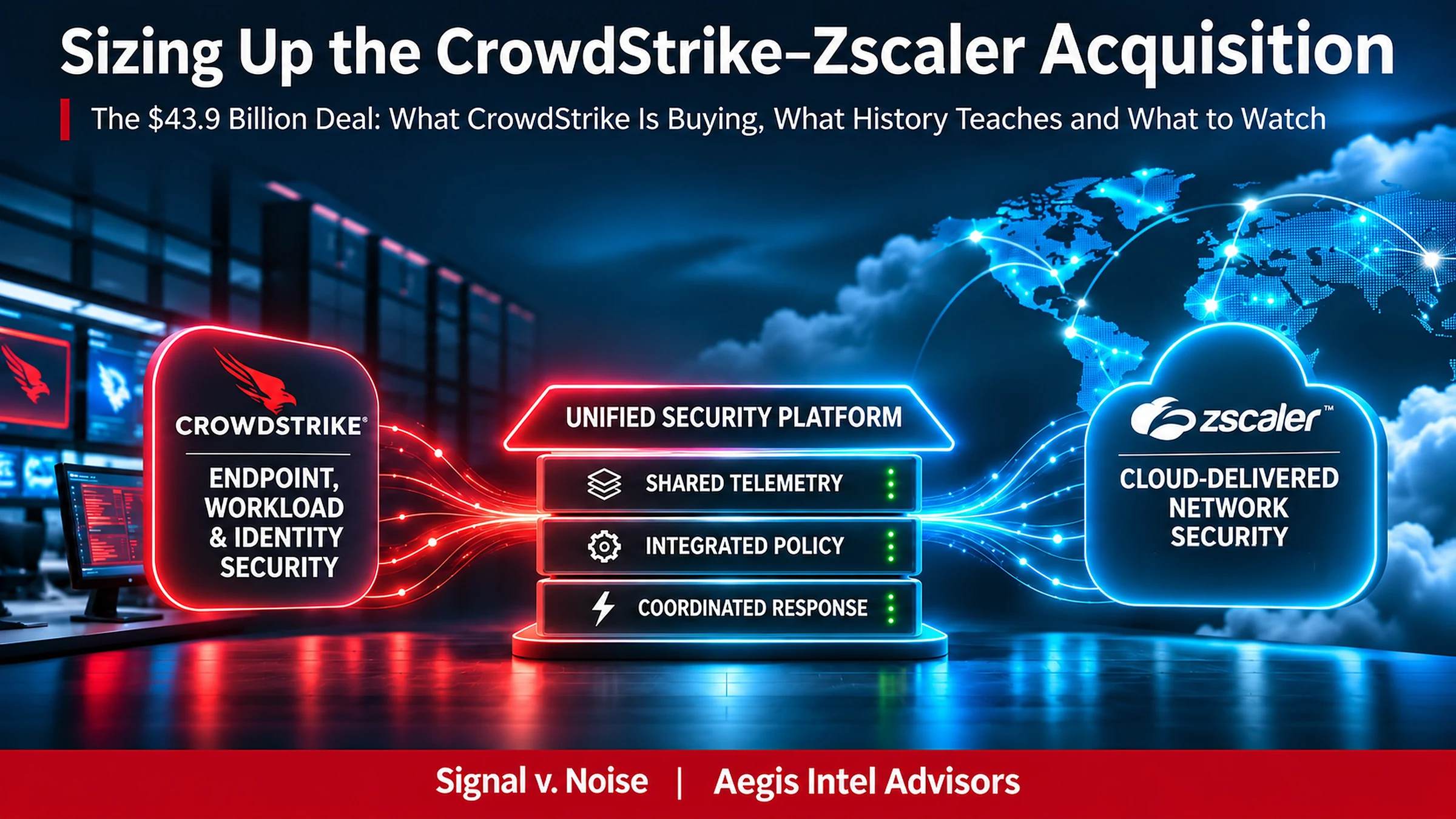
Second, CrowdStrike’s stated reason is to enter network security at scale, a market it calls cybersecurity’s largest single addressable segment. CrowdStrike protects endpoints, cloud workloads, identities and data; Zscaler inspects and controls the connections between users, applications and the cloud. Zscaler operates more than 200 service locations and processes more than 750 billion transactions a day. Reproducing that global inline network, which inspects traffic as it passes between users and applications, would require years of investment and operating experience.
Management also tied the timing to AI agents. George Kurtz described agents running on devices, invoking cloud models and communicating across networks, and envisioned “one detection, one decision and one kill switch” spanning endpoint and network controls. That is an intended outcome of integration, not a capability the combined company has already delivered.
In the investor-call transcript, Kurtz explained the decision to acquire rather than simply extend the partnership: “A partnership integrates separate products. One company integrates everything, the data, the roadmap, the go-to-market, the commercial model, and AI accelerates the integration.”
The commercial case rests on the installed bases. The companies report more than 2,000 shared customers and 16 integrations, while approximately 8,000 Zscaler customers do not yet buy CrowdStrike.
After closing, CrowdStrike plans to offer Zscaler products through Falcon Flex, its purchasing model in which customers commit spending up front and allocate it across eligible products, and through its partners.
Management targets $1 billion in annualized revenue synergies within 30 months of closing and $500 million in annualized cost synergies within 18–24 months. It also estimates that the acquisition adds more than $185 billion to its addressable market in calendar 2029. These are management projections, not realized results.
Why Pay for Zscaler Instead of Netskope, Cato or Another Vendor?
At the announced enterprise value, CrowdStrike is paying about 11.3 times Zscaler’s latest reported $3.9 billion in annual recurring revenue (ARR). Netskope reported $899 million in ARR as of July 31, 2026 and had an equity market capitalization of roughly $9 billion to $10 billion on November 20.
That makes Zscaler roughly 4.3 times as large by ARR and the announced transaction roughly 4.4 to 4.9 times Netskope’s market value. These are directional scale comparisons, not like-for-like takeover valuations: enterprise value differs from equity value, and Netskope’s market price includes no hypothetical acquisition premium.
Cato Networks, a private company, reported more than $415 million of ARR in July 2026, up 42% year over year. Cloudflare’s November 20 market capitalization was about $98.5 billion, and network security is only part of its larger connectivity business. Both illustrate the trade-off: a smaller target would cost less but bring less revenue and infrastructure, while Cloudflare would be a far larger and less focused acquisition. Zscaler offered an established global network, customer base and a long-running working relationship with CrowdStrike.
CrowdStrike’s Network-Security Partnerships Compared
The disclosed partnerships also differ in breadth. The comparison below describes public evidence, not an exhaustive inventory of every integration. In the table, zero-trust access means verifying users and devices before granting narrowly scoped access to applications rather than broad access to an internal network. SIEM (security information and event management) collects and analyzes security events to detect threats, investigate activity and support incident response.
| Dimension | CrowdStrike–Zscaler | CrowdStrike–Cato | CrowdStrike–Versa |
|---|---|---|---|
| Relationship history | Multiyear strategic alliance | Announced July 2026 | Announced September 2025 |
| Publicly documented integration scope | 16 integrations (company-reported) | Three publicly described use cases¹ | Two publicly described integrations¹ |
| Technical scope | Endpoint posture, zero-trust access, threat intelligence, SIEM, automated response | Threat investigation, asset/device visibility, SIEM telemetry | Risk-based access enforcement and SIEM telemetry |
| Joint commercial activity | Established joint selling and ecosystem collaboration, including Red Canary | Public partner/channel collaboration | Technical joint offering; no comparable disclosed joint-selling scale |
| Documented shared customers | 2,000+ (company-reported) | Not publicly quantified | Not publicly quantified |
| Forward development / status | Additional shared-signals, telemetry and response work announced; not all generally available | Three integration use cases stated as generally available | Published access-policy and SIEM workflows |
¹ Cato and Versa counts refer to use cases or integrations described publicly, not independently audited totals.
The distinction is not that Cato or Versa provided superficial connections. Both had substantial technical integrations. Zscaler’s advantage was the combination of a longer relationship, a company-reported 16 integrations, more than 2,000 disclosed shared customers and explicit joint commercial activity. Acquiring Zscaler therefore bought more than another product connection; it brought a mature distribution and engineering relationship inside CrowdStrike.
Netskope is also a CrowdStrike partner. CrowdStrike named Netskope a Project QuiltWorks partner on August 31, 2026. The following day, Netskope detailed three Falcon integrations, including a device-risk workflow that can trigger a Netskope policy response. CrowdStrike already had ways to exchange risk signals with multiple network-security vendors; buying Zscaler is a decision to own network enforcement and commercial scale, not simply to make endpoint and network products communicate.
There is an important financial qualification. CrowdStrike’s shares traded at a substantially higher forward revenue multiple than Zscaler’s in analysts’ pre-announcement estimates, making stock an attractive acquisition currency.
That does not reduce the value transferred to Zscaler shareholders or eliminate dilution. Nor does Zscaler’s approximately 13% year-to-date share-price decline before the talks establish that CrowdStrike bought it cheaply. The premium is justified only if the acquired scale and subsequent integration generate adequate returns.
What Acquisition History Teaches
Cybersecurity acquisition history offers cautions rather than a simple rule that buying a category leader succeeds or fails. Several large acquisitions eventually resulted in divestitures or corporate separations, although the circumstances and financial outcomes differed substantially:
- Symantec/Veritas: Symantec acquired storage and backup software leader Veritas in a transaction announced at approximately $13.5 billion and completed in 2005; it sold Veritas to Carlyle in 2016 for approximately $7.4 billion ($7.0 billion net of cash left in the business). Veritas is a cross-sector integration example, not a pure cybersecurity acquisition.
- Symantec/Blue Coat: Symantec acquired web-security company Blue Coat for approximately $4.7 billion in 2016. Broadcom bought Symantec’s broader enterprise-security business in 2019. That later sale demonstrates corporate restructuring, but does not separately establish the financial outcome of Blue Coat.
- McAfee/Stonesoft: McAfee acquired firewall maker Stonesoft for approximately $389 million in 2013. Forcepoint acquired the Stonesoft next-generation firewall and Sidewinder businesses for approximately $57 million in January 2016; the divested asset perimeter was not necessarily identical to the original transaction.
- FireEye/Mandiant: FireEye completed its approximately $1 billion acquisition of Mandiant on December 30, 2013, and announced it publicly in January 2014. In 2021 FireEye sold its product business and name to Symphony Technology Group for $1.2 billion; Google bought Mandiant for $5.4 billion in 2022. The separation shows that the original combination did not remain intact, but Mandiant’s later sale also demonstrates the enduring value of its services franchise.
Smaller purchases followed a different path. Palo Alto Networks bought Demisto for $560 million and Expanse in a transaction announced at approximately $800 million including replacement equity awards; both contributed capabilities to its security-operations and exposure-management portfolio.
CrowdStrike also bought Preempt for approximately $96 million and Humio for approximately $400 million, extending Falcon into identity security and the logging technology behind LogScale and Next-Gen SIEM.
Cisco, meanwhile, retained the Duo name after acquiring the identity-security provider for $2.35 billion in 2018.
These examples show different ways to preserve specialized capabilities, not proof that a particular integration model guarantees success.
Against that history, Zscaler differs from CrowdStrike’s earlier acquisitions.
At $43.9 billion, its announced valuation is roughly 59 times the $740 million headline price announced for CrowdStrike’s earlier SGNL acquisition. Zscaler also brings a different way of enforcing security, inspecting traffic in the cloud rather than on the device, and a network-security buyer, usually a different team from the one that buys endpoint security, rather than an adjacent module that can readily be folded into Falcon.
CEO Chaudhry’s planned continuing role may help retain its expertise and customer relationships, but the critical test is whether engineering integration and commercial autonomy can coexist.
Timing and Where the Deal Ranks
The companies expect completion in the second half of CrowdStrike’s fiscal 2028, August 2027 through January 2028, subject to Zscaler shareholder approval, regulatory clearances and other conditions. Holders of approximately 34% of Zscaler shares signed voting-support agreements. The merger agreement sets a November 23, 2027 outside date, with a conditional extension to February 23, 2028 if only specified antitrust or foreign-investment conditions remain. The required regulatory jurisdictions were not fully listed in the public filing.
At its $43.9 billion announced enterprise value, CrowdStrike–Zscaler is the largest announced purchase of a cybersecurity company to date. For context, Google’s Wiz deal was announced at $32 billion and closed March 11, 2026; Cisco acquired Splunk for approximately $28 billion in March 2024; and Palo Alto Networks completed its approximately $25 billion announced CyberArk acquisition in February 2026. These headline figures are not identical valuation measures: Google, for example, reported an acquisition price of $29.5 billion for Wiz after adjustments, compared with its originally announced $32 billion.
What to Watch
- Customer retention and vendor neutrality. Watch whether Zscaler retains customers using Microsoft Defender, SentinelOne and other competing endpoint products, and whether CrowdStrike maintains the third-party integrations and data access those customers depend on. Strong cross-selling is valuable only if it exceeds any lost business from perceived lock-in. Regulatory scrutiny of third-party interoperability is another issue to monitor, but no such condition has been announced for this transaction.
- Delivered technical integration. Look for production releases that correlate endpoint, network and identity data, apply coordinated policies and take verifiable response actions without introducing unacceptable latency or operational risk. A shared presentation or bundled contract is not the same as a unified enforcement platform.
- Financial delivery. Separate incremental product adoption from contract repackaging, and compare management’s progress against its $1 billion annualized revenue-synergy and $500 million annualized cost-synergy targets. Monitor margin, free cash flow, Zscaler customer retention and growth independently of the promised synergies.
CrowdStrike is buying network-security scale immediately, but it is not buying the completed integrations anticipated for regulatory approval and fiscal merger success.
The transaction’s success will be measured by whether the two platforms remain attractive to existing customers while delivering better security outcomes and financial returns than their partnership could have produced on its own.
Disclosure: The author is a former CrowdStrike Director and holds CrowdStrike equity.